hero background image

Voice commerce:
how it works, value & adoption hurdles

December 9, 2025

Voice commerce: an operating principle & typical scenarios

Voice commerce relies on the use of voice-enabled devices connected to software solutions that are powered by natural language processing (text-to-speech, speech-to-retrieval, voice recognition technologies, etc.). With AI at their core, these technologies can understand user intent and perform corresponding actions. For example, a consumer can use a virtual assistant, such as Siri, Amazon Alexa, or Gemini, to search for a product, request information about it from a specific store, place an order, and check delivery status. Here is an example of how voice commerce works, illustrated by a typical product discovery process.

Voice input capture

First, a consumer gives a voice command to a virtual assistant via a smart speaker or mobile device, asking it to find a product, such as a pair of jeans in a specific size and color. Automatic speech recognition algorithms capture this request and convert it into text.

Input processing

Then, natural language processing (NLP) models analyze the converted text to understand the user’s intent and elicit key information, such as product type and preferred store location.

Decision-making & task execution

After interpreting the customer request, the AI model determines whether the input contains enough parameters to search for the product and make a decision. If some details are missing, like whether the product is intended for men or women, or the preferred brand, the model asks clarifying questions.

Once all the ambiguities have been resolved, it scans ecommerce stores’ product databases for relevant items, retrieving product pricing, quantity, and availability details that match the request. At this stage, the model can utilize previously recorded information about the shopper’s past purchases, as well as products added to a shopping cart or wish list, to provide personalized recommendations. Additionally, it updates the buyer persona information with the newly collected user insights for future interactions.

Response generation

Once the ML models identify the products that match the user’s intent, the text-to-speech component generates a natural-language response presenting the findings, including relevant details such as prices, sizes, and ratings. The assistant then gathers user feedback and asks clarifying follow-up questions until the user’s request is fully resolved.

After the customer selects a product, the system determines its availability across store locations and moves the user into the checkout flow. The assistant collects purchase and delivery details and completes the payment process through internal systems.

Automatic speech recognition Natural language processing Decision-making & task execution Natural response generation & text-to-speech conversion

Scheme title: Voice commerce framework

Boost sales with a tailored voice commerce solution

Contact us

Benefits of voice commerce

Voice commerce, also known as v-commerce, complements the traditional online shopping experience, providing specific benefits to businesses, such as collecting detailed customer data, reducing friction in the shopping journey, and accelerating the order placement process.

Improved customer experience

By enabling hands-free product discovery and purchases and replicating the traditional, in-store shopping experience, voice commerce-powered software makes shopping more intuitive, leading to higher customer satisfaction, which contributes to better conversion rates, increased sales frequency, and long-term customer retention.

Increased consumer base

With voice search and product ordering, retailers can reach new audiences eager to use smart devices, as well as busy consumers who prefer to place orders on the go. Apart from that, voice commerce solutions allow retailers to make their services accessible to people with physical disabilities, enabling them to purchase products via voice commands.

Better audience understanding

Voice commerce solutions, including those driven by conversational AI, collect customer data that can’t be gathered in the case of traditional shopping, such as what questions people ask before making a purchase and their current emotional state. Moreover, as the client uses voice commands, they can request products or specifications that aren’t currently available. This enables businesses to better understand the demand of their target audience, shoppers’ behavior, sentiment, and preferences to fine-tune marketing campaigns, adjust customer support conversations, and deliver personalized experiences.

Reduced customer support costs

By enabling customers to find answers to their questions on their own, conversational commerce solutions reduce the number of requests to the support team, allowing companies to save money on hiring more support employees.

Challenges of implementing voice commerce software & how to solve them

Challenge

Solution

Ensuring interpretation accuracy
Voice commerce solutions can produce incorrect outputs due to the complexity of interpreting different languages, accents, slang, and professional jargon, leading to customer frustration.

Establish a robust fallback mechanism to prevent dead ends when the system encounters different speech patterns. Set up your voice commerce solution so that if it doesn’t understand a customer query for the first time, it asks a clarifying question. If it fails to understand the query twice in a row, direct the customer to a human operator.

Maintaining human-like conversations
Some shoppers are reluctant to use voice-enabled solutions as the conversation feels robotic, generic, and formal. As a result, ecommerce business owners can’t achieve the expected ROI of their voice commerce solutions.

To provide a satisfying user experience, configure your solution to mimic how your human agents talk, including their speech tone, rhythm, and voice pitch. Start by analyzing and annotating voice recordings of conversations between your employees and customers. Involve data annotation specialists to specify the tone, pitch, speech rate, pauses, and emotional cues in each dialogue to provide the model with the required parameters. Consider also implementing dedicated voice cloning models that can replicate a person’s voice to create natural-sounding AI voices.

Voice commerce best practices

Voice commerce best practices

Adjusting the search engine optimization strategy

When searching for information using voice, consumers tend to use conversational, long queries and complete sentences. Optimize your website content, such as the homepage, as well as category, product, and shipping and returns pages, to meet those requests. This entails introducing long-tail keywords that reflect natural speech, including FAQ sections to answer common questions, and breaking down the text into bullet points, numbered lists, and short paragraphs for easy reading. Additionally, consider improving your technical SEO by adding structured data markup to specify which parts of a web page should be read aloud by voice assistants.

Optimizing the shopping experience

Create a smooth purchase flow by eliminating complex product categories, multi-layered filters, and lengthy product lists and enabling the “Buy Now” capability for faster purchasing. Additionally, automate habitual tasks like subscription renewal and product reordering by enabling shoppers to pre-authorize payments for future orders. Moreover, integrate the voice commerce solution with ecommerce predictive analytics tools powered by AI that can forecast customer needs based on past behavior, other consumers’ purchases, and overall market trends and provide timely product recommendations.

Ensuring the continuous evolution of the solution

When implementing the voice commerce solution, set clear metrics to measure the impact of the new technology on customer behavior. Track the amount of sales made via digital assistants, how the overall amount and value of orders have changed after introducing the voice commerce solution, and whether the number of support inquiries has dropped. Collect user feedback on their experience with the AI agent, either using the ratings system or open-ended questions, and employ the insights to refine the voice commerce experience.

Preventing voice spoofing

Voice commerce solutions are vulnerable to cyberattacks, attracting cybercriminals, who try to mimic customer voice patterns. By doing so, they attempt to gain unauthorized access to user accounts to either steal customers’ payment details or to make purchases on their behalf. To reduce the risk of voice spoofing or impersonation attacks, implement systems that employ anti-spoofing techniques to identify synthetic voices and block suspicious users. Moreover, when the client makes frequent or large purchases within a short period of time, ask them to provide additional verification, for example, by sending a code to a phone number.

Personalizing the voice shopping experience

Instead of delivering generic replies, the voice commerce solution should be able to adjust to shoppers, which significantly improves the customer experience. To make this possible, start by developing key buyer personas who are most likely to shop via voice and define their typical purchase journey, preferences, and expectations. Then, design the voice commerce experience around these personas and configure the solution so that it remembers clients’ preferred product attributes and prior purchases to personalize results using real customer data. For advanced personalization, consider implementing an AI-powered recommendation engine and integrating it with the voice assistant.

Looking for a trusted partner to implement a voice commerce solution?

Turn to Itransition

Real-world voice commerce examples

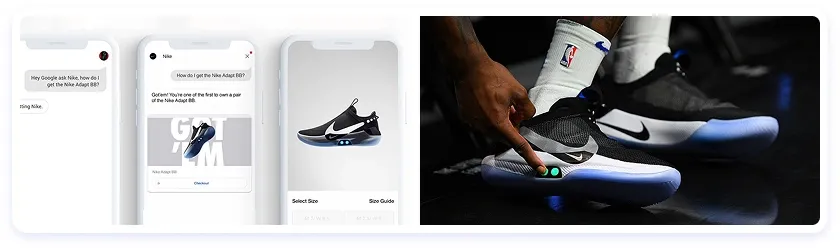
Nike collaborated with RAIN, a company developing voice and conversational AI solutions, and R/GA, an advertising agency, to introduce their new Nike Adapt shoes and enable the voice commerce experience during TNT’s live telecast of a Lakers/Celtics game. Basketball viewers could communicate with Google Assistant using voice to learn more about the product and buy it in real time. The shoes sold out in six minutes during the live telecast, with 85% of users completing their orders.

Nike

Image title: Nike voice commerce solution
Image source: RAIN

Starbucks enables customers to order their drinks via Google Assistant, which, in turn, retains their preferences, saving consumers the effort of repeating the same information. By using order history, the assistant can also offer relevant products to each customer, matching the products they typically buy with details such as the time of day and the weather.

Video thumbnail

A home improvement retailer, Lowe’s, partnered with OpenAI to deploy Mylow, a conversational AI-powered advisor embedded into their website. The solution allows users to ask open-ended questions using both text and voice and provides detailed instructions on home renovation, personalized product suggestions, and links to videos and articles that explain how to perform certain tasks. Powered by the GPT‑4o model, Mylow understands user intent, increasing customer confidence in navigating renovation projects, exploring product options, and making purchasing decisions.

Video thumbnail

A French multinational retailer, Carrefour, partnered with Google to provide customers with a voice commerce experience via Google Assistant. The solution communicates with users in natural language, allowing them to buy groceries, while integrating their purchase history and preferences to provide personalized offers. Another initiative of the retailer was launching an online voice assistant. This solution can add products to shoppers’ carts based on their recipes, as well as provide information about nearby stores, such as their addresses, opening hours, and how to get there.

Itransition’s voice commerce services

At Itransition, we offer comprehensive ecommerce development services, helping brands implement solutions equipped with voice commerce functionality.

Consulting

We provide advisory services, helping you develop a detailed strategy for implementing a tailored voice commerce solution in line with your business model and objectives. We analyze your ecommerce and business needs, as well as the current technological landscape, helping you define requirements for the voice commerce solution and select the optimal tech stack, and deliver expert assistance during the implementation project.

Implementation

We deliver tailored voice commerce solutions, ensuring their security, efficiency, and interoperability with your systems to facilitate an end-to-end shopping process. We provide comprehensive implementation services, from an in-depth analysis of your business needs and technical infrastructure to solution development, deployment, and post-launch support. Upon request, we provide voice commerce solution monitoring and optimization services, enhancing its capabilities, performance, and accuracy in line with evolving user needs.

Streamlining the shopping experience with voice commerce

Today, customers want to have multiple channels to interact with online retailers, and voice commerce is one of the approaches that can help brands meet this demand. As technologies like generative AI are progressing, voice commerce is set to gain traction due to its convenience, the personalized experiences it offers, and its ability to streamline the purchase journey.

Voice-based commerce solutions allow shoppers to find products and make payments using voice commands, as well as enable them to perform basic tasks, like checking product availability, order status, or the return policy, without typing or using screens. They can help you create a smooth purchase journey, offering you a competitive edge, more repeat orders, and higher revenue. And if you want to adopt the technology and ensure its efficiency and long-term value, our experts at Itransition can facilitate successful voice commerce solution implementation.