Services
SERVICES
SOLUTIONS
TECHNOLOGIES
Industries
Insights
TRENDING TOPICS
INDUSTRY-RELATED TOPICS
OUR EXPERTS
April 14, 2026
bn
the forecasted agentic AI in manufacturing and industrial automation market value in 2030
the expected CAGR of agentic AI in manufacturing and industrial automation market
of manufacturing enterprises rank process automation as their top investment priority
Scheme title: Global RPA market segmentation by industry
Data source: Grand View Research
Agentic and robotic process automation solutions find diverse applications within manufacturing companies, streamlining both front-office and back-office operations.
RPA and agentic automation solutions can help speed up the procurement cycle, minimize manual errors, and free time for supplier negotiations, executing a large number of operational tasks:
To free up inventory managers and warehouse staff from manual data entry, document processing, and constant inventory status tracking, companies can use RPA bots and agents driven by artificial intelligence to automatically perform the following tasks:
Accounting departments in manufacturing companies can implement RPA and agentic software to automate the following manual processes, ensuring data consistency and minimizing financial losses:
Manufacturing teams can use software robots and AI-powered agents to streamline the generation of bills of materials and ensure their accuracy, relevance, and comprehensiveness by automating the following manual processes:
Robotic and agentic process automation solutions are being actively implemented in manufacturing to support quality control teams, automating processes such as:
Order management is a tedious process consisting of many labor-intensive tasks that can be streamlined with the help of agentic automation or RPA tools:
Manufacturing businesses can integrate RPA bots and AI-powered agents within their IT systems to entrust them with tasks related to manufacturing equipment maintenance, automating equipment data handling, staff alerting, and task coordination, preventing costly breakdowns and downtimes, and facilitating predictive maintenance:
As regulatory requirements applicable to the manufacturing sector evolve and keeping track of all of them becomes challenging, companies are seeking ways to streamline compliance procedures. Process automation solutions can be highly helpful in making sure that manufacturers meet such requirements at every stage of the manufacturing process while maintaining operational efficiency by performing the following tasks:
Software bots and agents can also prove useful in customer relationship management, performing routine tasks, such as:
In this demo video, Itransition’s experts show how RPA bots perform intelligent invoice processing by automating the collection, extraction, and entry of unstructured invoice data.
tax code accuracy achieved
Struggling with erroneous tax code selection during the procurement process, Siemens, a multinational technology conglomerate, decided to implement the UiPath AI Center solution within their China Supply Chain Management (SCM) and Siemens Global Business Services (GBS) teams. The deployed software robots rely on machine learning models trained on historical data and prebuilt tax code rectification rules to automatically detect and eliminate incorrect tax codes contained within purchase orders, improving tax code accuracy and reducing human intervention.
The combination of AI and automation technologies significantly improves productivity and customer satisfaction and strengthens our supplier collaborations.
reduction in manual effort
Somany Impresa Group, a leading Indian conglomerate focusing on the manufacturing of building products, consumer appliances, and packaging products, collaborated with UiPath to implement its AI-powered automation solution across 80+ business operations.
Powered by OCR, computer vision, and generative AI capabilities, the solution streamlines the processing of vendor invoices and shipping documents, identification and blocking of inactive vendors, and generation of vendor aging reports. Additionally, the automation solution facilitates invoice submission through the customer portal and tasks associated with subcontracting work to external parties. Furthermore, it streamlines the candidate screening process for recruiters, reducing operating costs and human error.
AI-powered automation is a key element in our business transformation strategy, essential for improving efficiency and competitiveness. AI has been a catalyst bringing an additional layer of intelligence, taking automation’s impact from incremental to exponential.
hours saved for the European team
Sappi, a leading global manufacturer of pulp and paper products, utilized UiPath to implement 132 software robots. Specifically, they launched a bot using UiPath’s Document Understanding solution that processes around 12,000 PDF-based booking confirmations annually, aggregating 80% of documents straight through. In the finance department, another RPA bot is used for report generation, reducing the time needed for this process from one hour to three minutes.
The robot does what a human does, but much faster and more accurately. But there’s always a human-in-the-loop to handle any exceptions.
manual entry hours per supplier saved
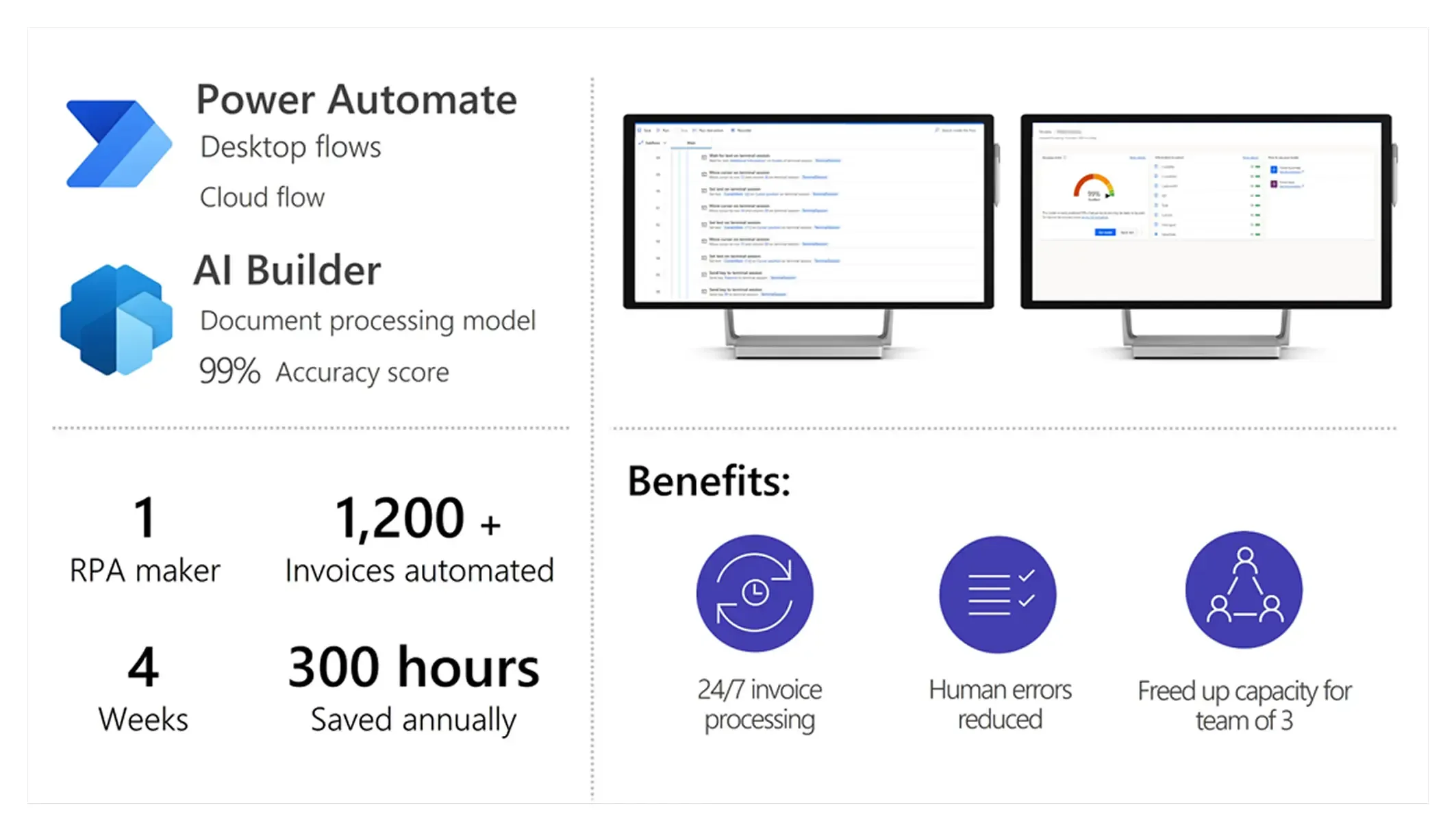
Komatsu Australia, a global manufacturer and distributor of forestry, mining, and construction equipment, implemented the Microsoft Power Platform, including its Power Automate and AI Builder components, to automate their end-to-end invoice processing workflow. The solution scans incoming emails and documents, validates invoice data against purchase order details, delivers invoice data to the dedicated database, and generates and distributes exception reports to stakeholders if data mismatches or missing information is detected. By combining AI and RPA, the company eliminated inefficiencies in the invoicing process, saving hundreds of hours of work.
Image title: Komatsu Australia’s RPA project results
Image source: Microsoft
Operating around the clock, RPA bots and AI-powered agents can perform mundane administrative operations like data entry and processing both during and after business hours, allowing manufacturing companies to maintain continuous business operations.
Automation solutions input, aggregate, validate, and cross-reference production and financial information with high precision, minimizing the risk of errors that occur when employees perform the same tasks manually.
By saving hundreds of human workers’ hours, RPA and agentic automation solutions help manufacturers decrease operational costs to free up financial resources for strategic initiatives that drive profitability.
By implementing RPA and agentic automation solutions to handle low-value, repetitive tasks in customer relationship management, sales representatives and support agents can switch to direct customer communication, improving the customer experience and satisfaction.
By streamlining labor-intensive and high-volume data management activities, companies reduce strain on human workers, enabling them to meet tight deadlines and enhancing their productivity.
Process automation solutions can effectively handle increasing volumes of repetitive, time-consuming operations across procurement, inventory, and order management, facilitating operational scalability without compromising on task execution quality.
RPA bots and AI agents generate audit trails of automated manufacturing operations, recording every action performed to ensure transparency and accountability and facilitate compliance reporting for manufacturing companies.
Demonstrating steady growth over the past few years, the market for RPA and agentic automation solutions offers multiple tools that can help manufacturing companies automate repetitive tasks. Here are the leading solutions that frequently secure top positions in vendor rankings by Gartner and Forrester Research.
UiPath is a leading platform for building both software bots and autonomous agents, having 10,000+ customers worldwide, including manufacturing giants like Johnson Controls, Canon, Xerox, and Siemens. The platform offers a comprehensive feature set to automate supply chain management, financial, human resource, and contact center workflows.
Power Automate is a part of Microsoft’s Power Platform suite, along with Power BI and Power Apps. Combined with Azure automation services and Copilot, the solution enables the development of rule-based and intelligent automation solutions for manufacturing businesses of all sizes.
Automation 360 is Automation Anywhere’s solution that supports both robotic and agentic process automation, helping manufacturers optimize business processes across inventory, BOM, order, and customer service management.
S&C Blue Prism offers a suite of RPA and agentic automation capabilities applicable to diverse use cases in manufacturing, including supply chain management, BOM generation, order management, customer service, and quality assurance.
Issue | Solution | |
|---|---|---|
Resistance to change |
Fear that automation will displace human workers, especially as software robots become more sophisticated,
can cause resistance to change among employees, hindering the implementation of automation solutions.
| To reduce employee concerns, companies should clearly communicate the benefits of automation in improving efficiency and productivity. One of the ways is to showcase studies of other manufacturers achieving tangible benefits thanks to automation. Additionally, it’s recommended to provide training and upskilling opportunities to help the staff adapt to new workflows and tools, as well as develop new skills needed for more creative, higher-value tasks. |
High initial costs of automation |
Upfront costs required to implement automation solutions, including software, hardware (if needed), and user
training investments, can be substantial for resource-constrained businesses.
| To offset the initial financial burden, manufacturers should adopt a phased approach, gradually introducing process automation into their operations, starting with the most critical and well-defined tasks. This allows businesses to assess the impact of software bots and address challenges on a smaller scale without risking disrupting core processes. |
Scalability concerns |
Over time, a manufacturing organization can decide to scale their automation initiative, which can be hard
if the existing process automation solution isn’t built for growth.
| When selecting RPA and agentic automation technologies, manufacturing companies should choose automation software that offers both RPA and agentic automation capabilities to be able to launch not only simpler bots but also more sophisticated agents in line with increasing process complexity. Additionally, it’s essential to opt for solutions that offer centralized orchestration and governance to coordinate the work of multiple bots and agents more easily. In terms of deployment options, hosting an automation solution in the cloud is more preferable, since it’s easier to proportionally increase computing and storage resource consumption when using the cloud rather than local servers. |
We analyze your current operational workflows to design the agentic automation or RPA solution and plan out its non-disruptive deployment. Additionally, we deliver the solution’s PoC and a clear project roadmap for implementing the full-scale automation solution, as well as comprehensive guidance on its development and implementation into your IT ecosystem.
To implement the agentic automation or RPA solution in line with your business needs, our team thoroughly examines your processes and technologies. Then, we create the solution’s architecture, select the right tech stack, and develop the solution, performing rigorous reliability and compliance testing and conducting end-user onboarding. Upon request, we also perform solution monitoring and optimization, troubleshoot arising issues, and add new automation capabilities to meet evolving business requirements.
Manufacturing companies are under immense pressure to deliver results in the face of market instability, workforce shortages, and rising material and transportation costs. Recognizing the benefits of RPA and agentic automation, companies across all industries, including manufacturing, are actively adopting process automation solutions to enhance employee productivity and prevent costly human errors.
By relieving employees of tedious, repetitive tasks, RPA bots and AI agents allow them to focus on higher-value work, such as decision-making, problem-solving, demand forecasting, and production planning. However, to stay competitive when stepping into digital transformation and make sure that the new technology doesn’t bring disruptions to the business, expert guidance from a reliable agentic automation or RPA service provider like Itransition becomes essential.
RPA solutions automate rule-based tasks, such as collecting data from digital documents, entering it into ERP software or report templates, tracking inventory levels, and sending predefined notifications to manufacturers.
Agentic automation solutions leverage OCR, NLP, and generative AI, enabling agents to process unstructured data and execute multi-step workflows, taking action based on the context. For example, AI-powered automation solutions can extract data from images and PDFs, autonomously handle basic exceptions, such as mismatches between order data and invoice details, and route notifications from production line equipment to appropriate maintenance specialists.
No, one of the strengths of RPA and agentic automation solutions is that they easily connect to legacy software with limited integration flexibility, interacting with them via software user interfaces and mimicking human actions. To enable deeper integration, you require a tailored integration strategy that can combine diverse application integration approaches, including developing custom APIs, deploying middleware like an enterprise service bus, and implementing iPaaS software. At Itransition, we’re proficient at all of them, developing custom integration solutions for different systems.
The cost of RPA or agentic automation implementation for the manufacturing industry varies depending on multiple factors, including the number and complexity of the processes to be automated, the number and complexity of integrations with software systems, the automation platform’s pricing, and the number of bots and agents to launch. In general, the cost of implementing a single bot or agent can start at $5,000–$10,000, while the automation of several complex processes can cost up to $300,000.
Service
We deliver tailored process automation solutions for workflows of varying complexity, helping companies reduce manual effort across business operations.
Insights
Explore the top 10 use cases and successful implementation examples of robotic process automation for various industries.
Insights
Explore the top ten RPA benefits for your business, supported by examples from across industries, as well as RPA market trends and adoption barriers.
Insights
Learn about the use cases and examples of agentic automation and RPA in automotive and explore the tips for ensuring effective implementation of such solutions.
Insights
Explore the use cases, examples, and benefits of financial RPA and agentic automation and learn how to overcome challenges when implementing these solutions.
Insights
Explore the use cases of agentic automation and RPA in insurance, their real-life examples, benefits, and guidelines for effective process automation adoption.